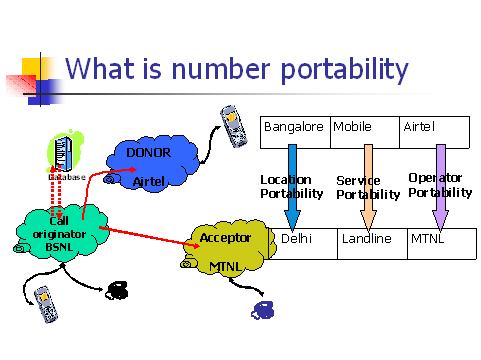
Number Portability
allows subscriber to change their service provider to one having –
the best service quality
lower tariff options,
& better network coverage
while retaining their old telephone number.
Technological reasons for implementing
Arguments against implementation - India not yet ready; Implementation requires large technological changes;
My Argument why it should be implemented
Our Mobile network is state of the art; technically much better than many countries where MNP has already working
We introduced many services ahead of USA e.g. GPRS
Fixed line NP may have problems; can be sorted and taken up in next stage
If it can work in S Korea – 2004; Greece – 2004; Lithuania – 2005; Belgium – 2000; Honk Kong - 1998
why not in India
Arguments against implementation - India not yet ready; Our tele-density is still much below developed countries; We should concentrate on increasing tele-density; We have enough operators for competition
My Argument why it should be implemented
Mobile nos. in India are largely in Urban areas. Our urban tele-density is ~35.
We added almost 17m mobiles in last 4 months. That means urban teledensity is increasing >6 in last four months.
Requires 12-18 months in implementation after decision. Urban tele-density may cross 50 by then. following table indicate that we will be at par or better than developed countries in terms of tele-density for implementing Number Portability(NP)
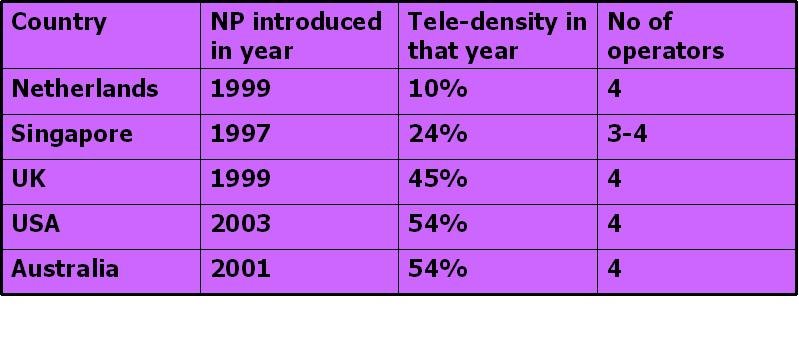
For one service say GSM mobile we have maximum 4 operators per service area
Economic reasons
Arguments against implementation - Implementation require huge initial investments, which will outweigh the benefits. Concentrate on improving service quality
My Argument why it should be implemented
Its exactly the service quality for which we need NP
Today India has one of the lowest rates for mobile services but quality of service offered is poor
NP eliminates pseudo and psychological barriers to churning thus providing truly competitive market and service quality improvement
Some estimate costs as high as 5000 Cr for implementation which are amplified and incorrect estimate even for implementing full fledged NP across services, operators & Locations
Implement just Mobile NP, then fixed
Call forwarding technology requires not much costs
Even other technologies for mobile number portability we require central database, routing and query arrangements. It will not cost more than 150 cr to implement.
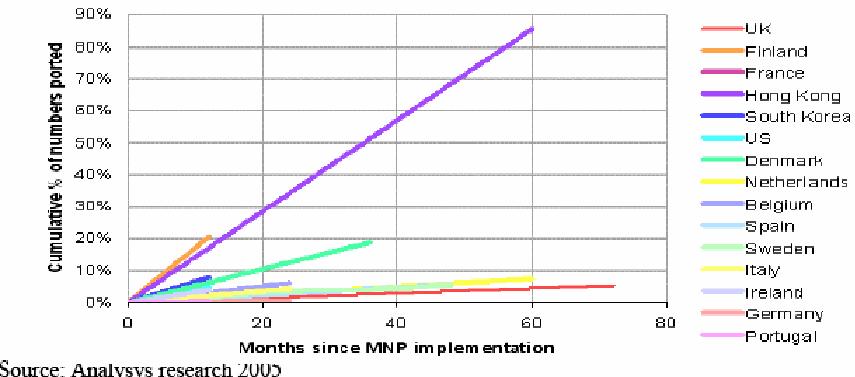
India has 85m mobile connection now. By 2007 they will be more than 150m. Even if 10% use NP we have 15m users. (Spain 3m used.); International Data Corporation India conducted a survey and found that “30% of mobile subscribers are likely to shift to an operator offering better service, if given the option.” Internationally 10% churning of numbers with NP is common as shown in following figure-
Charge of Just Rs 200 can cover costs. Internationally average charges are around 12-14$.
If consumer is ready to pay for better service and availing better tariffs, why it should not be implemented
Operational reasons
Arguments against implementation - Implementation will have problems of distortions by donor networks
My Argument why it should be implemented
Good planning and proper regulations on following issues can help in smooth operations –
Go for all India implementation
Don’t go for call forwarding option
Locking of handsets to be banned
Address lock in period problems
Costs to be collected and born by recipient networks
Operational problems can always be sorted out in time. After all India is not the first country to implement the NP
Conclusion
India is well prepared for introducing number portability
It should be introduced in phased manner –
Mobile number portability across the nation amongst all operators
Then fixed number portability
Non implementation of NP will negate the concept of “True market” and operators will go on compromising on service quality standards


No comments:
Post a Comment